

|
est. 1988, Westerville, Ohio
|

Amendment information
Specific changes and rationales for amendments
Vote on these amendments here!
If approved, language changes may be clarified during legal review, so the final form may be slightly different but will have the same meaning. Language to be deleted appears in strikethrough, and language to be added is highlighted.
|
Amendment 1 of 12 |
|
|
General Warranty Deeds Article I, Section Q |
ANTENNAS: Television, radio antennas and dish-type satellite signal receiving stations, whether roof-top or ground mounted, shall be prohibited on the exterior of any house or lot Restriction has been removed. |
|
Rationale by Michael Rudy |
Receivers for satellite and other signals were large and unsightly when these deeds were written in 1988. This is no longer a problem, because satellite dishes and TV antennas are much more compact and barely noticeable now. We do not need to prohibit this equipment any longer, so the entire section can be deleted. In order to avoid renumbering, a placeholder may remain. |
|
Amendment 2 of 12 |
|
|
General Warranty Deeds Art. I § G |
TEMPORARY STRUCTURE: No temporary building, trailer, garage, storage building or structure shall be placed upon any lot for storage purposes without the express written consent of Grantor the Homeowners Association, as defined in Article II. Any such building must reasonably match the appearance of the house in view of the Association, and no such building shall have a size larger than [size determined by vote]. If allowed to fall into disrepair or become unsightly, such building must be repaired or removed at the owner’s expense. |
|
Rationale by Michael Price |
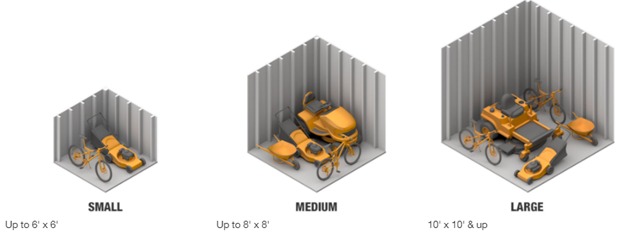
Residents have complained that it is difficult to park two cars in their garage. Cars are bigger today than 30 years ago. Average car sizes have increased over the last thirty years, taking up more space in garages than when the community deed was created, therefore limiting space available for outdoor storage tools, lawn maintenance products and machinery such as rakes, shovels, grass seed/fertilizer, blowers, lawn mowers and other common tools. Shed size examples are shown here, courtesy of the Home Depot:
|
|
Comments |
The current deed allows the Grantor, M/I Homes, to approve storage buildings, i.e. sheds, but the Grantor has not been involved for decades. Sheds have never been allowed by the HOA, even though a few exist. Many residents have expressed the desire to build a shed. Several residents have found alternative storage solutions for outdoor equipment, such as garage additions and basement storage. Steven Stoan stated that not allowing sheds causes more cars parked in driveways and on streets. Terri Liston stated that the concern with sheds has always been that once they are installed, they require continual upkeep and maintenance. If that is allowed to lapse, this detracts from the aesthetic character of the neighborhood. La’Tonia Stiner-Jones added that once a shed is constructed, the board and neighbors have little if any power to have it removed. Unmaintained sheds can turn into eyesores and have a direct negative impact on adjacent homeowners and resale values. They can also become targets for thieves, since they are not attached to the house and often contain expensive equipment. |
|
Amendment 3 of 12 |
|
|
General Warranty Deeds Art. I § S |
FENCING: Except as specifically provided herein, no chain link, metal or plastic fencing shall be permitted upon any of the lots within The Village at Westbury. Ornamental metal and vinyl fencing may only be installed with the express written consent of the Homeowners Association, as defined in Article II. |
|
Rationale by Michael Price |
Metal and plastic fencing aesthetic and quality has improved over the last 30 years since the deeds were created and may add value to the community in conjunction with traditional wood fencing. At least one resident already has a black metal fence with high aesthetic quality on Westray Drive. |
|
Comments |
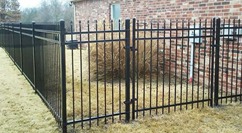
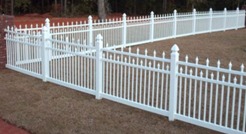
Ornamental metal and vinyl fence examples are shown below. These fences tend to be significantly more expensive than wood fences and are easier to maintain. Wood fences would still be allowed as they always have been. |
|
Amendment 4 of 12 |
|
|
General Warranty Deeds Art. I § C |
TRADE, BUSINESS OR COMMERCIAL ACTIVITY BARRED: No trade, business or commercial activity, including daily or weekly rental of all or part of a house, shall be conducted upon any lot, nor shall anything be done thereon which may become an annoyance or nuisance to any of the owners of any lot in The Village at Westbury, provided, however, the sale of a lot or a house by any property owner shall not be considered to be a commercial activity as defined herein. |
|
Rationale |
Several homeowners expressed concern that allowing short-term (Airbnb-type) rentals will take away from the sense of pride that owners have in maintaining their properties. Short-term rentals of one or two rooms are allowed by our zoning code, but 3+-room rentals are prohibited by the zoning code. Short-term rental of a whole house, if the owner does not occupy it, is subject to state building codes similar to hotels. Therefore, this amendment would effectively ban short-term rentals of one or two rooms in a house, which would otherwise be allowed. |
|
Amendment 5 of 12 |
|
|
General Warranty Deeds Art. I § D |
PLAN APPROVAL: For the purpose of maintaining specific architectural guidelines and standards for the development of all lots within The Village at Westbury… [all existing paragraphs of this section]… Each lot owner further agrees that no changes to exterior paint colors, siding or roofing materials shall be commenced until such changes have been approved in writing by the Homeowners Association, as defined in Article II, through its Board of Directors, or until thirty (30) days have passed after submission of plans to the Board, if the Board has not communicated a decision thereon. |
|
Bylaws Article VIII, Committees |
The Board may appoint a Beautification Committee to create a Design Review Plan to assist the board in evaluating changes to exterior paint colors, siding materials and roofing materials. The Board may additionally appoint a Nominating Committee, as provided herein, and may appoint such other committees as it deems appropriate in carrying out its purposes. |
|
Rationale by Danellia Givens |
I present an idea of having a “Design Review Plan” in place to help maintain standards set forth from M/I Homes and to continue with harmony. To ensure and inspire potential homebuyers of our standards and cohesiveness. For 79% of potential homebuyers believe that curb appeal is very important in purchasing a home and neighborhood. By having a Design Review Plan in place, this will continue to encourage the growth of neighborhood property value, build one’s equity, and maintain outdoor visual attractiveness. This also continues with the vision of value and pride in our neighborhood and to inspire others of our standards and cohesiveness here at Village at Westbury. |
|
Comments |
This was seconded by Lori Storch and opposed by Marcia and Doug Hatfield. |
|
Amendment 6 of 12 |
|
|
General Warranty Deed 1988 Art. III § C and General Warranty Deed 1989 Art. III § B |
ENFORCEMENT: Enforcement shall be by proceedings at law or in equity, or both, by any owner of any part of the above-described real estate or by Grantor the Association, through its Board of Directors against any person or persons violating or attempting to violate any covenant and either to restrain violation or recover damages. No failure to object to any violations of any restrictions or to enforce any restrictions shall be deemed a waiver of the right to do so thereafter, either as to the same violations or as to one occurring prior or subsequent thereto.
The Association may also assess fees against any owner of the above-described real estate, on whose Lot a violation of any covenant occurs, in the amount of twenty (20) dollars for each day during which such violation occurs. These fees, like other sums assessed to a Lot, are secured with a continuing lien as described above. |
|
Rationale |
After the proposal of amendment 5, for the association to regulate paint colors, roofing and siding, Randall Weaver stated that if an association wishes to undertake such regulation, it needs a stronger enforcement mechanism, which usually takes the form of a daily fine in other HOAs. |
|
Comments |
The association or any homeowner may take legal action against any other homeowner for violating any of the deed restrictions, but this is rare, slow and costly. Ben Travis stated that following the deed restrictions has generally been based on the honors system here, which works out well when homeowners occupy their own properties and take collective responsibility. Michael Rudy expressed the concern that enacting a fine may create antagonism between homeowners and the HOA. |
|
Amendment 7 of 12 |
|
|
General Warranty Deeds Art. I § I |
WASTE DISPOSAL: No lot shall be used or maintained as a dumping ground for rubbish. Trash, garbage or other waste shall not be kept except in sanitary containers. All equipment for the storage or disposal of such material shall be kept in a clean and sanitary condition and removed from view from the street and abutting properties except on a collection day and the evening before a collection day. |
|
Rationale by Michael Rudy |
Prohibiting the storage of trash cans in view of abutting properties, i.e. behind houses, does nothing to increase neighborhood aesthetics. It is also burdensome, and increasingly so now, since Westerville introduced the large blue recycling carts. A similar change was proposed five years ago by a previous board. |
|
Amendment 8 of 12 |
|
|
General Warranty Deeds Art. I § N |
BOAT, TRAILER AND VEHICLE PARKING AND STORAGE: No truck, trailer, boat, camper, recreational vehicle or commercial vehicle shall be parked or stored on any lot unless it is in a garage or other vehicle enclosure out of view from the street and abutting properties; provided, however, that nothing herein shall prohibit the occasional nonrecurring temporary parking of such truck, trailer, boat, camper, recreational vehicle or commercial vehicle on the premises, reasonably removed from the flow of traffic, for a period not to exceed forty-eight (48) hours seven (7) days in any period of thirty (30) days. |
|
Rationale by Michael Rudy |
We do not want permanent visible storage of boats, trailers and RVs, but sometimes more than two days are needed to clean, repair and prepare them. Such temporary parking should not impede visibility and traffic flow. This is a common issue, and we should poll the neighborhood about it. |
|
Amendment 9 of 12 |
|
|
General Warranty Deeds Art. I § P |
SIGNS: No signs of any kind shall be displayed to the public view on any lot, except one temporary sign of not more than six (6) square feet advertising the property for sale or rent, or signs used by the builder to advertise the property during the construction sales period as may be allowed under the zoning code political signs within thirty days of a general or primary election, or other signs if removed within forty-eight (48) hours after placement. |
|
Rationale by Michael Rudy |
It is reasonable to allow homeowners to display signs for a day or two, such as construction and party signs. Several neighbors also have wished to display political signs, so it is worth finding out whether our neighborhood wants this. A similar change was proposed five years ago by a previous board. |
|
Amendment 10 of 12 |
|
|
General Warranty Deed 1988 Art. III § B and General Warranty Deed 1989 Art. III § A |
TERM: These covenants are to run with the land and shall be binding on all owners of the above-described real estate until December 31, 2010, after which time said covenants shall automatically be extended for successive periods of ten (10) years by a majority two thirds (67%) of the then owners of the lots agreeing in writing to amend said covenants in whole or in part. |
|
Rationale by anonymous |
A supermajority of 67% can help to prevent a small majority from eroding fundamental rights of a large minority. I say this because as a community any changes made to our properties or living conditions will impact everyone on our community, whether it is sheds, fences, boats, recreation vehicles, etc. As such, I believe that more than just a simple majority of the current 51% is sufficient. We need to ensure that any changes that impact our properties and our community rights require a strong majority of the homeowner members. I recognize that some changes need to be made to the deeds and bylaws to bring us into our current era. And I would support those on an individual basis. I believe that we need to have the vote of membership on this issue and allow all to determine if a change needs to be made to a requirement of 67% supermajority. |
|
Comments |
This would apply to future amendments. As written before, amendments require a majority (or supermajority if this passes) approval of all homeowners, not just those who bothered to vote. A simple majority means 66 lots must vote in favor, and the supermajority proposed here means 88 lots would need to vote in favor of an amendment. If our documents did not specify this, state law (O.R.C. 5312.05) would require the consent of 75% of the owners for amendments, which would be 99 lots. |
|
Amendment 11 of 12 |
|
|
General Warranty Deed 1988 Art. III § B and General Warranty Deed 1989 Art. III § A |
TERM: These covenants are to run with the land and shall be binding on all owners of the above-described real estate until December 31, 2010, after which time said covenants shall automatically be extended for successive periods of ten (10) years by a in perpetuity. A majority of the then owners of the lots must agreeing in writing to amend said covenants in whole or in part. |
|
Rationale by Michael Rudy |
The automatic extension of the deeds for periods of ten years is confusing, and there is no reason why homeowners should not be able to amend our governing documents whenever desired. A similar change was proposed five years ago by a previous board. |
|
Amendment 12 of 12 |
|
|
Bylaws Article IV, Government |
Section 1. The Village of Westbury Subdivision is composed of 131 consecutively numbered lots. In accordance with Exhibit I attached hereto, the subdivision ls divided into ten (10) sections with nine (9) sections comprised of thirteen (13) lots and one (1) section comprised of fourteen (14) lots. The Board of Directors shall consist of the ten (10) section representatives four (4) Trustees, President, Secretary and Treasurer of the Association. Section 2. Election and Terms of Trustees. At the first annual meeting, lot owners/members in each section shall elect one (1) four (4) Representatives who shall serve as Trustees of Association. Each lot owner/member shall have one (1) vote provided that joint, common, or other multiple ownership of any of the lots shall not entitle the owners thereof to more than the number of votes which would be authorized if said lot was held under one name. The Representatives/Trustees shall be elected for a one (1) year term and at each annual meeting thereafter. The lot owners/members shall elect a Representative/Trustee to replace the Representative/Trustee when term expires. |
|
Rationale by Michael Rudy |
The division of the neighborhood into sections is administratively useful, but for a long time there has not been enough interest in volunteering with the HOA to have even close to ten trustees, let alone one from each section. This amendment would formalize the long-standing arrangement of the board. Reduction of the number of trustees was proposed by Will Chadwick in a poll on the old website; it had near-unanimous support. A similar change was also proposed five years ago by a previous board. |
Pages
- Home
- Maps
- Find us here!
- Lots, sections, taxes
- Transport, healthcare, schools
- Plats
- Directories
- Board of directors
- Services & contractors
- Documents
- Governing documents
- Messages
- Announcements
- Lost & found
- Classified ads
- Garage sales
- Recipes
- FAQs
- Exemption requests
- Contact us
- Social media
- Nextdoor
- Coronavirus help
- Survey results
- Amendments
- Amendment information
- Amendment voting results